Why Forged Wheels Can Be Stronger and Lighter
Understand how forging, heat treatment and wheel design work together, and why strength, stiffness, fatigue resistance and low weight are different questions.
A forged wheel can be light and strong because the manufacturing route gives its designer useful material properties to work with. Those properties create an opportunity, not an automatic result. The finished wheel still has to balance mass, stiffness, load capacity and durability for a defined application.
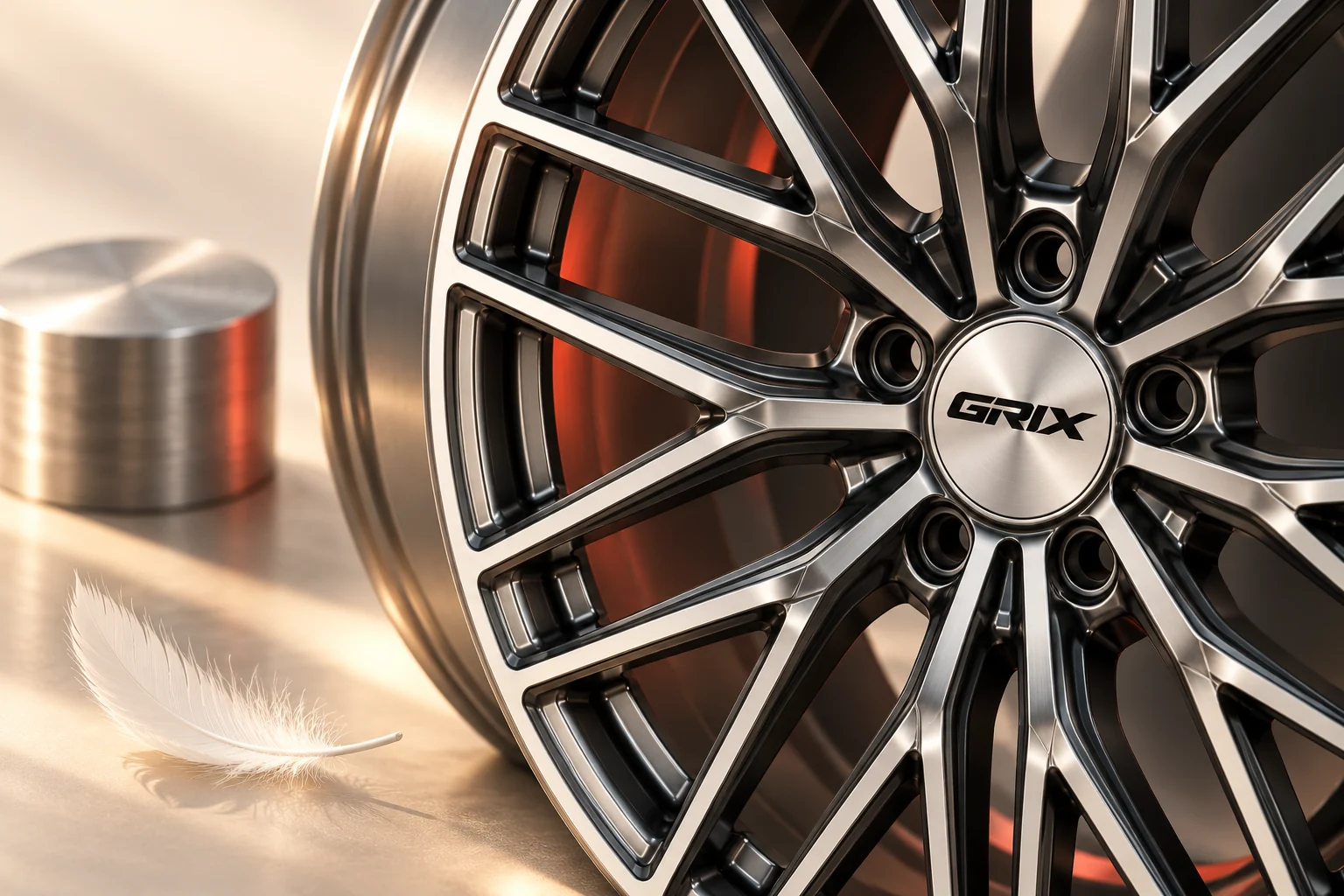
Forging changes the material before machining
Forming solid aluminum under pressure changes its internal structure and material flow. With suitable stock and controlled processing, this gives the designer a different starting point from a wheel formed by solidification. It is part of the explanation for the strength-to-weight potential of forged wheels.
Do not interpret that as a promise that every forged part is free of defects. Material traceability and process control still matter. Nor does a finished photograph reveal the internal structure: polished spokes, a deep concave face or visible machining marks are not a substitute for manufacturing records.
Technical references: BBS Japan material flow and wheel design
Heat treatment and alloy belong in the same discussion
An alloy designation does not describe the entire condition of a finished part. Heat treatment can change the mechanical properties of a heat-treatable aluminum alloy. In a controlled production route, forming, thermal processing and final machining are planned together rather than treated as unrelated selling points.
For example, a T6 condition generally involves solution treatment and artificial aging, with a quenching stage in the production sequence. It does not mean that every wheel carrying that designation has identical strength. Alloy, processing and geometry all remain relevant; no particular alloy or temper should be assumed for a GRIX model without its own supporting specification.
Technical references: Apex forged-wheel production process
Strength is not the same as stiffness
Strength concerns the level of loading a material or part can withstand before a specified failure condition. Stiffness concerns how much it deflects under load. Fatigue resistance concerns repeated loading over time. These are connected design questions, but they are not interchangeable descriptions of “strong.”
Spoke depth, cross-section, transitions and rim geometry influence how the wheel carries load. Removing material from a lightly stressed area is different from thinning every section equally. A dramatic cutout or a very thin spoke only shows a design decision; it does not establish whether the decision was validated.
Technical references: Enkei wheel engineering and MAT process
The weight benefit must survive an equal comparison
Suppose two proposed wheels have the same nominal size but different offsets, brake-clearance profiles or load requirements. Their geometries may differ enough that a simple weight comparison is misleading. Ask for the exact configuration and whether the stated mass includes the same accessories and finish condition.
The relevant question is how much mass has been removed while preserving the requirements of the application. There is no universal percentage by which every forged wheel must be lighter, and no reason to reject a design merely because additional material has been retained for a different duty.
Technical references: Apex on construction and finished-wheel strength
Rotating mass is useful context rather than a horsepower claim
A wheel translates with the car and rotates about its hub. In the simplified rotational relationship I = Σmr², the distance of mass from the axis matters as well as the amount of mass. Removing the same mass from the rim and from near the hub therefore does not have the same rotational effect.
That physics does not justify a fixed conversion such as “one kilogram at the wheel equals several kilograms in the body.” Tires, wheel diameter, speed, suspension and the rest of the vehicle all affect the result. Compare the complete wheel-and-tire package, and do not promise a specific acceleration, braking or fuel-economy improvement from wheel weight alone.
Ask for evidence at the finished-wheel level
Engineering analysis helps identify critical areas, while physical tests assess defined loading conditions. Radial fatigue, cornering fatigue and impact testing answer different questions; passing one is not a universal statement about every road hazard. Ask what specification was assessed and how the evidence applies to the wheel being offered.
For a purchasing decision, request the exact wheel size, offset, declared load capacity, weight and applicable testing information. The useful conclusion is that forging can support an effective design. The stronger claim that one finished wheel outperforms another requires evidence for those two products.
Technical references: OZ wheel development and testing