Wheel Offset Explained How ET Affects Fitment
Learn positive and negative wheel offset, calculate how width and ET move a wheel, and understand why a clearance calculation is not a fitment guarantee.
Wheel offset, usually marked ET, is the distance in millimeters between the wheel centerline and its hub mounting face. At the same width, reducing ET moves the wheel outward and increasing ET moves it inward. Once width also changes, both dimensions must be calculated together.
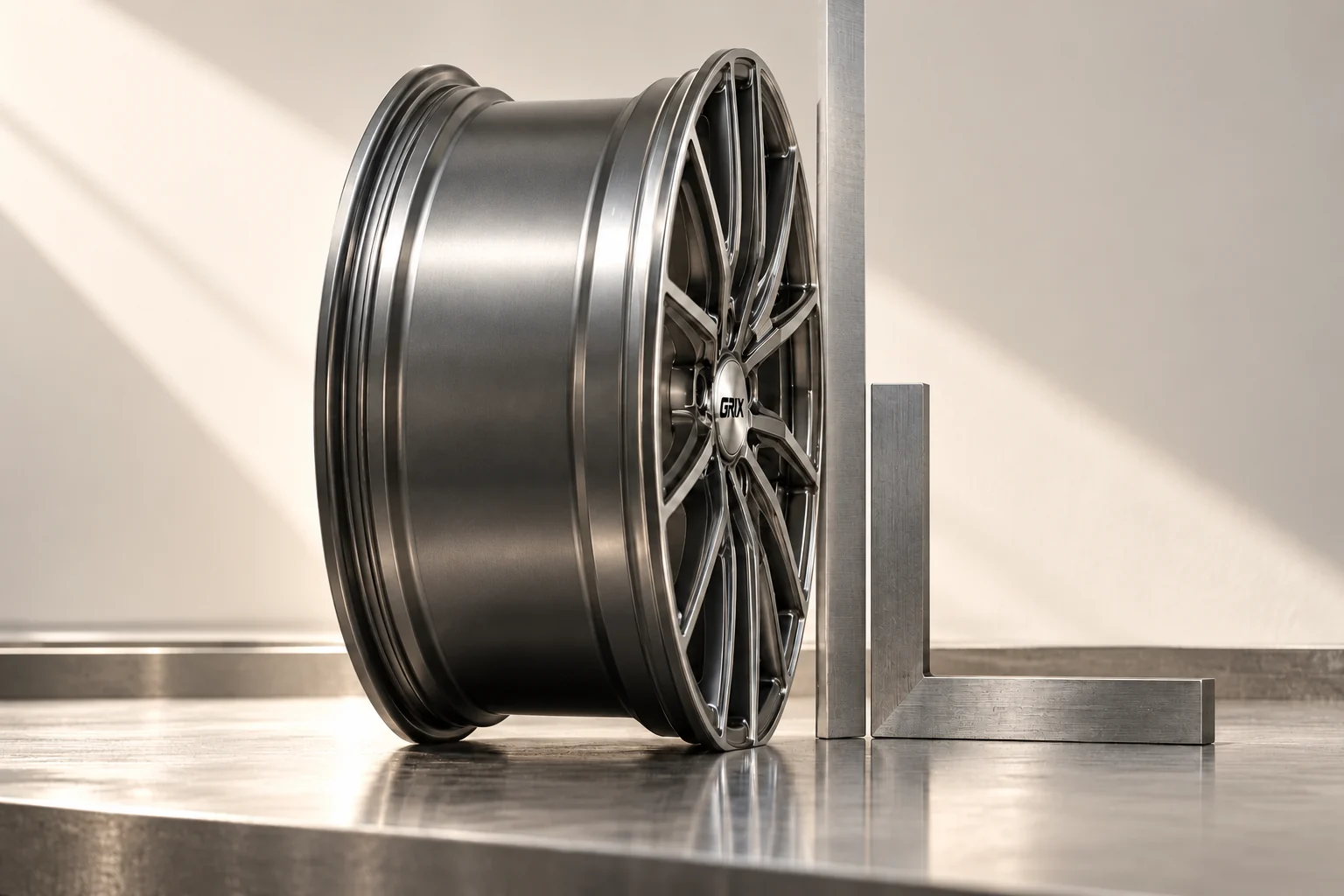
Read positive zero and negative offset correctly
Positive offset places the mounting face on the outer side of the wheel centerline. Zero offset places the face on that centerline; negative offset places it toward the inner side. These terms describe geometry, not quality or performance.
For a same-width replacement, changing ET45 to ET35 shifts the wheel outward by 10 mm relative to the hub. Its inner edge also moves outward by 10 mm. This statement assumes the same reference width and comparable rim-edge geometry; it does not describe spoke-to-caliper clearance.
Technical references: Tire Rack wheel offset guide
Calculate width and offset together
Let ΔW be the new nominal wheel width minus the old width, converted to millimeters. Let ΔET be the new offset minus the old offset. The approximate additional outward position is ΔW ÷ 2 − ΔET. The approximate additional inward position is ΔW ÷ 2 + ΔET.
A positive inward result uses more space toward the suspension; a negative result means additional clearance there. These equations compare the nominal rim positions. Actual flange shape, tire section width and operating movement must still be checked.
| Calculation | Result |
|---|---|
| Width increase | 0.5 in × 25.4 = 12.7 mm |
| Offset change | 35 − 45 = −10 mm |
| Additional outward position | 12.7 ÷ 2 − (−10) = 16.35 mm |
| Additional inward position | 12.7 ÷ 2 + (−10) = −3.65 mm |
| Meaning at the nominal rim edges | 16.35 mm farther out and 3.65 mm more inner clearance |
Why the tire and the car still need to be measured
A wheel-edge calculation is not a tire-clearance calculation. The mounted tire can extend beyond the rim, and its actual section width depends on the tire model and measuring rim. Two tires with the same nominal size need not have identical external dimensions.
Record the existing clearance to the suspension and body, then assess the proposed combination through the relevant steering and suspension travel. Lowering, alignment changes and a different tire shoulder can alter the result. A static photograph showing a flush wheel face cannot confirm clearance under load.
Offset does not define the spoke shape
Two wheels with identical diameter, width and ET can use different spoke profiles and mounting-pad shapes. One may clear a particular caliper while the other does not. Brake clearance therefore needs the wheel’s internal profile and the exact brake package, not just its offset number.
Changing offset also changes where the tire sits relative to the vehicle’s steering and suspension geometry. Avoid treating a large departure from the original specification as a styling-only adjustment. The allowable configuration should be assessed for the particular vehicle.
Technical references: Tire Rack wheel offset guide · Race Technologies brake-clearance guide
What a spacer changes
A spacer moves the wheel outward from the hub. In positional terms, effective offset equals wheel offset minus spacer thickness: a 5 mm spacer behind an ET40 wheel produces an ET35 position. This does not alter the wheel casting or forging, its barrel diameter or its original markings.
That calculation is not approval to install a spacer. Hub engagement, mounting-face contact, fastener specification and body clearance all need confirmation for the spacer system. Nor will moving a wheel outward necessarily resolve interference at the barrel.
Technical references: Race Technologies brake-clearance guide
What to send for a useful fitment answer
Provide the current and proposed front and rear sizes, their ET values, tire specifications, exact vehicle version and brake details. Add suspension changes and the location of any measured interference. Keep measured clearances separate from estimates.
If the current ET is unknown, a clear image of the wheel markings or its documented part number is more useful than an assumed value. GRIX can then discuss the intended position and the checks still needed before a configuration is confirmed.