Does a Matching Bolt Pattern Guarantee Wheel Fitment
A matching PCD is only the first check. Learn how center bore, fasteners, width, offset, brakes and load requirements determine real wheel compatibility.
No. A matching bolt pattern allows the wheel’s mounting holes to correspond with the hub, but it does not confirm that the wheel seats correctly, uses the right fasteners, clears the brakes or meets the vehicle’s requirements. Fitment is a set of conditions that must all be satisfied.
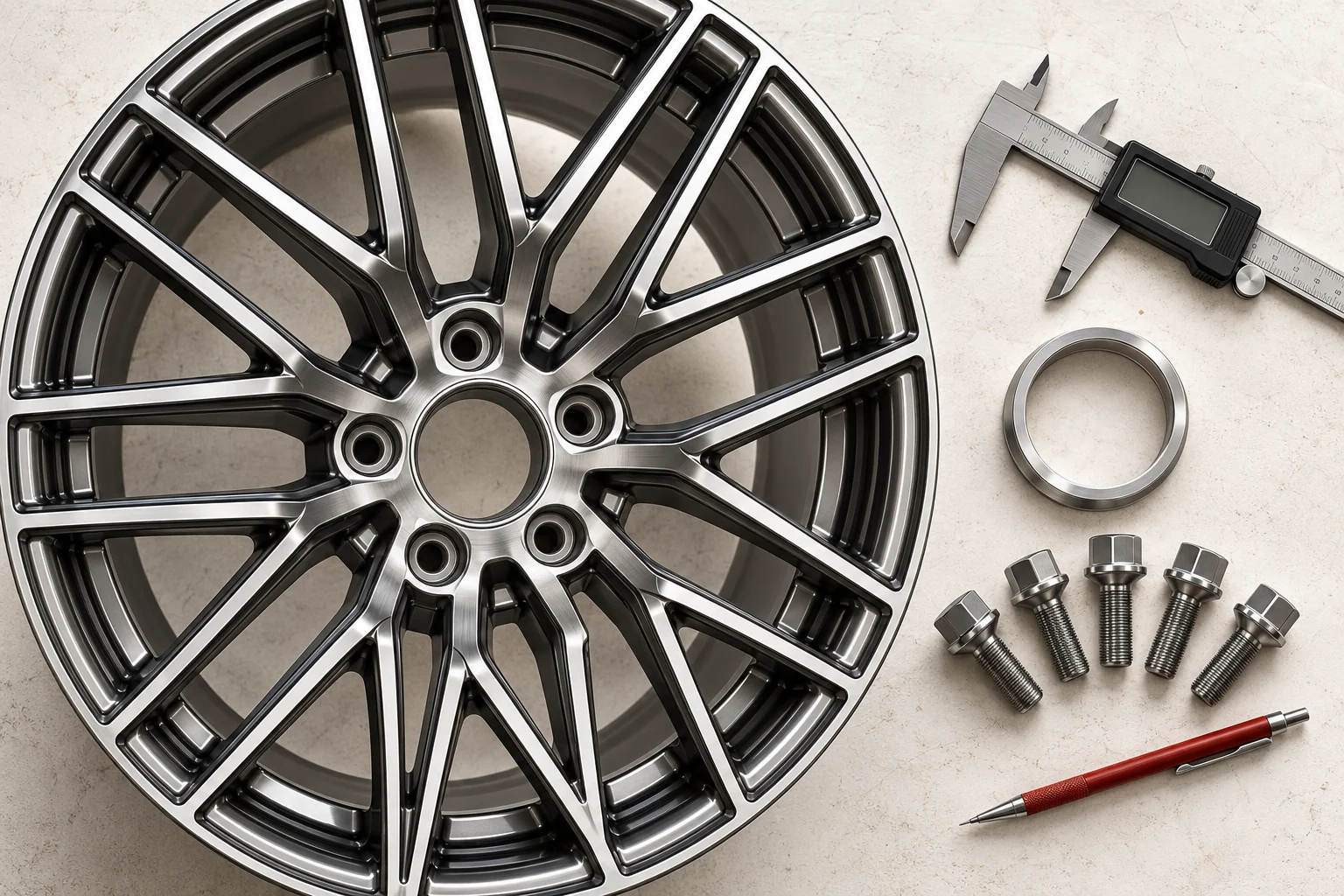
Understand what the bolt pattern actually specifies
A marking such as 5 × 112 identifies five fixing positions on a pitch circle with a diameter of 112 mm. The second number is not the distance between adjacent holes. On a five-lug wheel, a casual center-to-center measurement across two holes is not a reliable substitute for the specified PCD.
Do not treat close numbers as interchangeable. For example, 5 × 112 and 5 × 114.3 are different patterns. Verify the exact vehicle version and wheel part number. A wheel that appears to pass over the studs has not completed the compatibility check.
Technical references: Tire Rack bolt-pattern measurement guide
Check the center bore and mounting faces
The center bore must suit the vehicle’s hub and the wheel’s intended centering arrangement. Some wheels use a vehicle-specific bore; others use an approved centering ring. A ring can adapt an appropriately larger bore, but it cannot make a bore that is too small fit over the hub.
The wheel must also sit correctly against the mounting face. The apparent match of two bore diameters does not describe every detail of the interface, such as a chamfer or available locating depth. Have the actual combination checked instead of assuming that a ring solves every centering issue.
Technical references: Tire Rack center-bore guide
Use the fastener specified for that wheel
Thread diameter and pitch are only part of fastener compatibility. The seating surface may be conical, spherical or another specified form, and usable thread engagement must be appropriate. Original vehicle hardware is not automatically correct for an aftermarket wheel.
A fastener that turns into the hub or onto the stud may still have the wrong seat or length. It can bottom out without securing the wheel correctly, or interfere with components behind the hub. The installer should verify the wheel and fastener instructions together and use the specified tightening procedure.
Technical references: McGard fastener installation instructions
Check the space around the whole assembly
Width and offset determine where the rim sits, while the tire adds its own external profile. Suspension and body clearance need to be assessed with the intended tire, steering movement and suspension travel. A wheel intended for another trim can share the PCD yet still produce an unsuitable position.
Brake clearance is a separate check. Diameter alone does not establish the space behind the spokes or within the barrel. Verify the exact caliper and disc package, particularly where the vehicle has a factory brake option or an aftermarket upgrade.
Technical references: Tire Rack wheel offset guide · Race Technologies brake-clearance guide
Confirm the load and supporting components
The wheel and tire must each be suitable for the vehicle’s operating requirements. A shared bolt pattern is common across vehicles of different sizes and masses, so it cannot establish load suitability. Ask for the wheel’s declared application and supporting information for the actual specification.
Also confirm the intended tire’s permitted rim-width range, required load and speed specification, and any tire-pressure-monitoring provisions. A successful installation needs a compatible assembly, not simply four wheels with holes in the correct places.
Technical references: Continental tire upsizing requirements
Use a complete compatibility checklist
Treat the following as a record of what must be confirmed before ordering. An unknown item is something to investigate, not an invitation to choose the nearest available number.
- Exact year, model, trim and relevant brake or suspension changes.
- Wheel diameter, width, offset, PCD and center-bore arrangement for each axle.
- Correct fastener thread, seat and length for the proposed wheel.
- Brake envelope plus tire-to-body and tire-to-suspension clearance.
- Wheel suitability, tire specification, TPMS provisions and installation instructions.
Turn a PCD match into a confirmed specification
When contacting GRIX, include current wheel markings, tire sizes and the wheel design you prefer. If the car has been modified, identify the actual components rather than only naming the vehicle model. Clear photographs help identify the right documents but do not replace measured clearance.
A useful fitment answer should distinguish what is already supported from what still needs inspection. That is how a bolt-pattern match becomes a workable specification instead of a purchase based on one matching number.