How to Check Wheel Clearance for Big Brakes
Check a big brake kit against the exact wheel profile, including barrel, spokes and balance weights, using the correct clearance drawing and a verified test fit.
To check big-brake clearance, match the exact brake kit with the exact wheel specification and compare their physical envelopes. Wheel diameter and ET are useful information, but neither describes the full space behind the spokes or inside the barrel. A brake-specific drawing and a controlled test fit are the basis of a reliable answer.
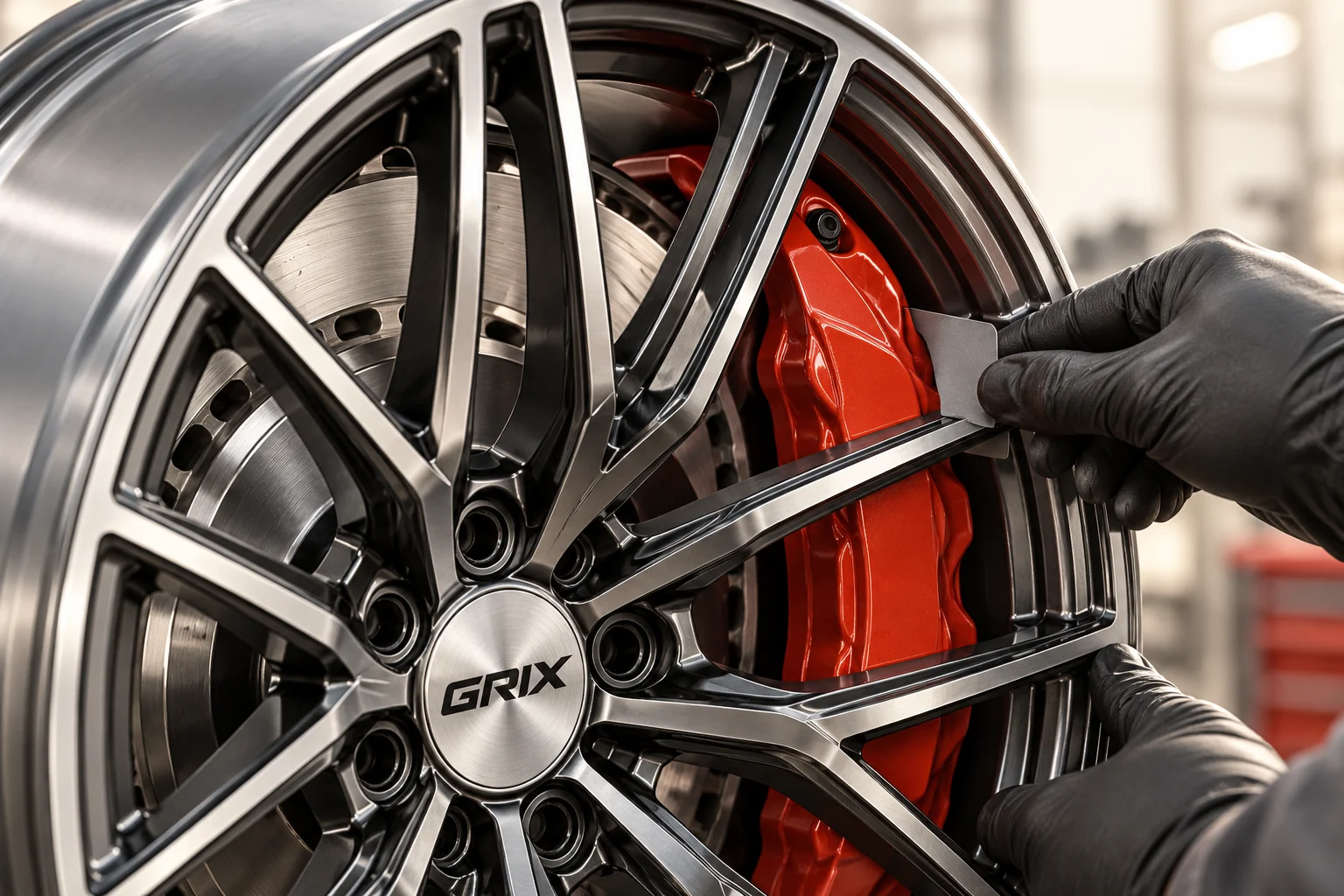
Identify the complete brake package
Record the kit or part number, axle, caliper, disc diameter and thickness, and the mounting arrangement. Two packages described casually as a six-piston upgrade can have different external profiles. Even similar calipers can sit differently when brackets or disc hats differ.
Use the brake manufacturer’s drawing for that exact assembly and revision. A template for a different vehicle, disc size or axle is not a substitute. When requesting advice, send the document itself rather than a photograph of a similar installation.
Technical references: Race Technologies brake-clearance guide
Check both radial and axial space
Radial clearance is the space between the brake envelope and the wheel barrel. Axial clearance includes the relationship between the caliper and the back of the spokes. Barrel steps, spoke curvature and the mounting-pad design can each matter.
A nominally larger wheel may still have inadequate spoke clearance. A deeper-looking face is also not a reliable measurement of the space behind it. Assess the internal profile of the proposed diameter, width and offset, not just another size carrying the same design name.
Technical references: Race Technologies brake-clearance guide
Use a correctly scaled clearance template
If the brake supplier provides a printable template, follow its instructions and verify the printed reference dimensions with a ruler. Disable page fitting or scaling unless the document explicitly calls for it. A print marked 100 percent is still worth measuring before it is trusted.
Keep the hub axis and mounting-face reference in the positions specified by the drawing. The brake envelope must be checked through the relevant wheel positions. Follow the stated margin and establish whether it is already included in the template outline; a universal clearance number should not be substituted for the kit instructions.
Technical references: AP Racing example clearance drawing P16.226
Include balance weights and the exact finished wheel
Adhesive balance weights can occupy part of the barrel clearance. Check their actual thickness and location with the installer, along with any other wheel features that enter the brake envelope. An unbalanced bare wheel clearing a template does not automatically prove that the completed assembly clears.
Ask for confirmation against the exact wheel part number or configuration. A photograph of the same vehicle with a similar-looking wheel cannot identify its spoke profile, brake assembly or hidden spacers. Installation visualizations, including AI images, are not clearance evidence.
Technical references: AP Racing example clearance drawing P16.226
Understand what a spacer can and cannot solve
A spacer can move a wheel outward and may change clearance behind the spokes, but it does not increase the barrel diameter. Any proposed solution must be checked against the whole brake profile; moving the wheel is not a general cure for interference.
The resulting position also changes effective offset and the tire’s relationship to the body. Confirm the specific spacer arrangement, hub location, fastener requirements and vehicle clearances before accepting it. Do not machine, grind or otherwise alter a caliper or wheel simply to make an unverified combination fit.
Technical references: Race Technologies brake-clearance guide · McGard fastener installation instructions
Finish with a controlled physical check
Have a qualified installer verify the assembly using the brake and wheel manufacturers’ procedures. Check for interference through wheel rotation and the vehicle movements relevant to the installation, then complete the required fastening and inspection process. A loose trial placement is not the final installed condition.
If the fit is uncertain, resolve the cause before use. The question to document is not merely “Does it rotate?” but whether the specified clearances and mounting conditions are maintained for the confirmed combination.
Prepare a brake-fitment enquiry that can be answered
Send the following information to GRIX before committing to a configuration. If a drawing is missing, obtain it from the brake supplier; a photo cannot reliably supply its dimensions.
- Exact vehicle year, model, trim and the axle being checked.
- Brake kit number and current clearance drawing with its revision.
- Proposed wheel model, diameter, width, offset and center-bore arrangement.
- Tire size, suspension changes and any existing or proposed spacer.
- Installer measurements and photographs identifying any interference.